Don’t Be Sad — Dance It All Away
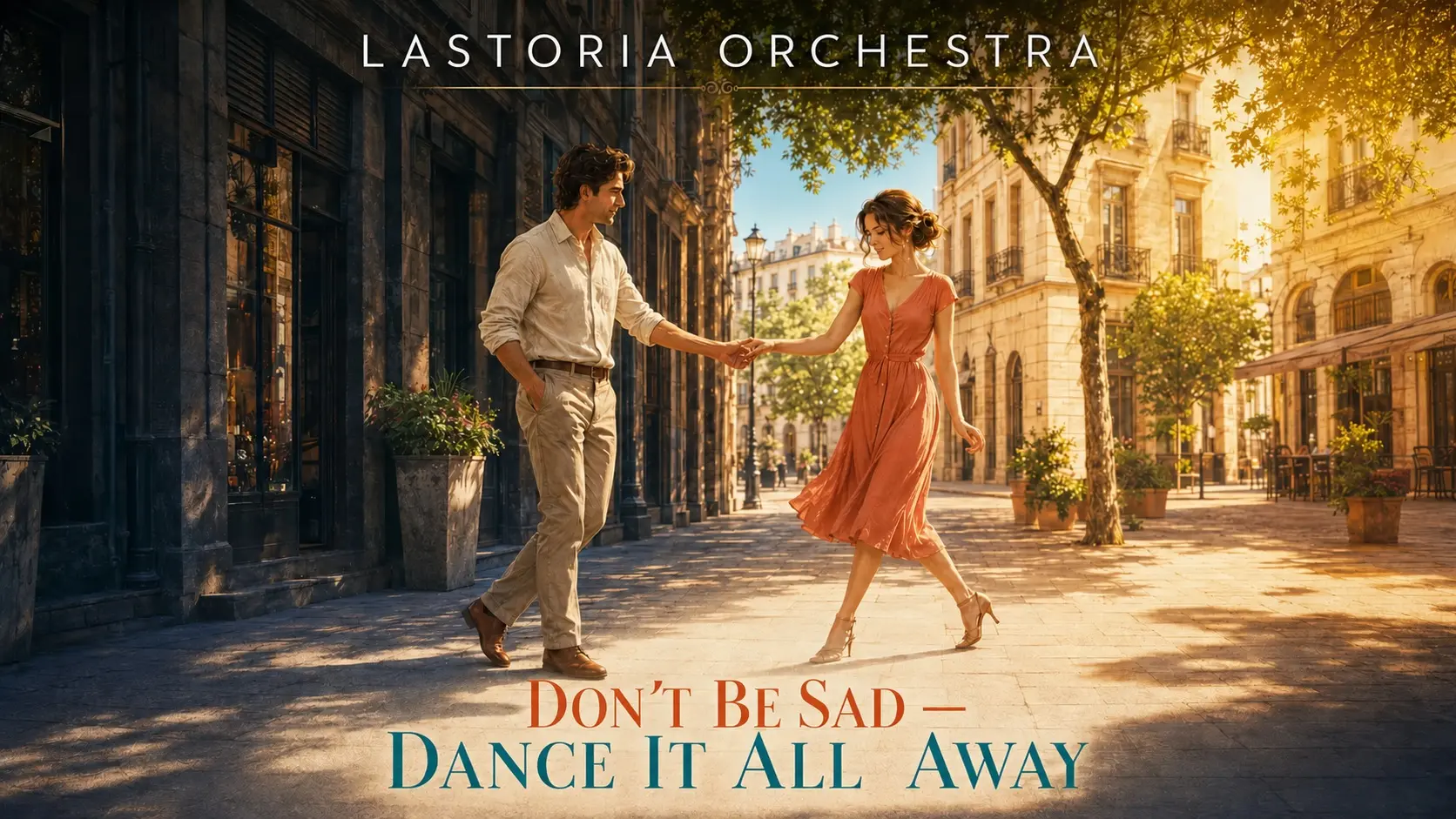
A young woman walks through a sunlit city street, carrying a sadness that keeps her apart from the easy rhythm around her. A young man notices, offers his hand and waits. Their first step is uncertain, but little by little the street opens into a shared dance and a difficult day grows warmer, lighter and more hopeful.
Listen to the composition
Ready to play
The first step
The street is filled with late-afternoon light. Café tables stand in the shade, leaves move above the pavement, and the city continues at its unhurried summer pace. A young woman walks through it all without really seeing any of it. Her steps are steady, but her attention is somewhere far away.
A young man notices her from a short distance. He does not hurry towards her or stand in her way. For a moment he simply walks beside her, leaving enough space for silence. Then he turns and offers his hand. The gesture is open and patient: an invitation, not a demand.
She looks up in surprise. For a second she cannot decide whether to stop or keep walking. Around them, nothing pauses. A chair scrapes softly across the pavement, someone laughs near a doorway, and patches of sunlight shift beneath the branches.
At last she places her hand in his. Their first movement is hesitant and slightly awkward, more like a question than a dance. Then he turns, she follows, and the rhythm begins to belong to both of them. They continue down the street half walking and half dancing, carried forward by a lightness that was not there a moment before.
Her sadness has not simply vanished, and the scene makes no grand promise that every difficulty has ended. It offers something quieter: one kind gesture, one shared rhythm and one good moment can make a heavy day easier to carry.
From inward steps to shared movement
The composition begins with motion already present, but its character is restrained and turned inward. The opening feels like a solitary walk: clear enough to keep moving, yet spacious enough to hold uncertainty and thought.
As the invitation enters the story, the musical space gradually becomes warmer and broader. A brief moment of hesitation creates contrast without breaking the flow. The piece seems to hold its breath and then resumes with greater freedom.
The change is not a sudden leap from sadness to celebration. The original movement is transformed rather than replaced. What first felt private and heavy becomes shared, lighter and more open, while the predominantly instrumental character of the work remains in the foreground.
The ending avoids a triumphant conclusion. It leaves the dance in motion, as though the two figures continue along the sunlit street beyond the final sound.
Credits and information
- Music
- Dmitry Lastov
- Lyrics
- Dmitry Lastov
- Artistic direction
- Dmitry Lastov
- Arrangement
- LASTORIA ORCHESTRA
- Performance
- LASTORIA ORCHESTRA
- Vocal parts
- LASTORIA ORCHESTRA
- Format
- Predominantly instrumental dance composition
- Vocal element
- Brief vocal phrases
- Created
- 2 August 2026