Inside the Aurora
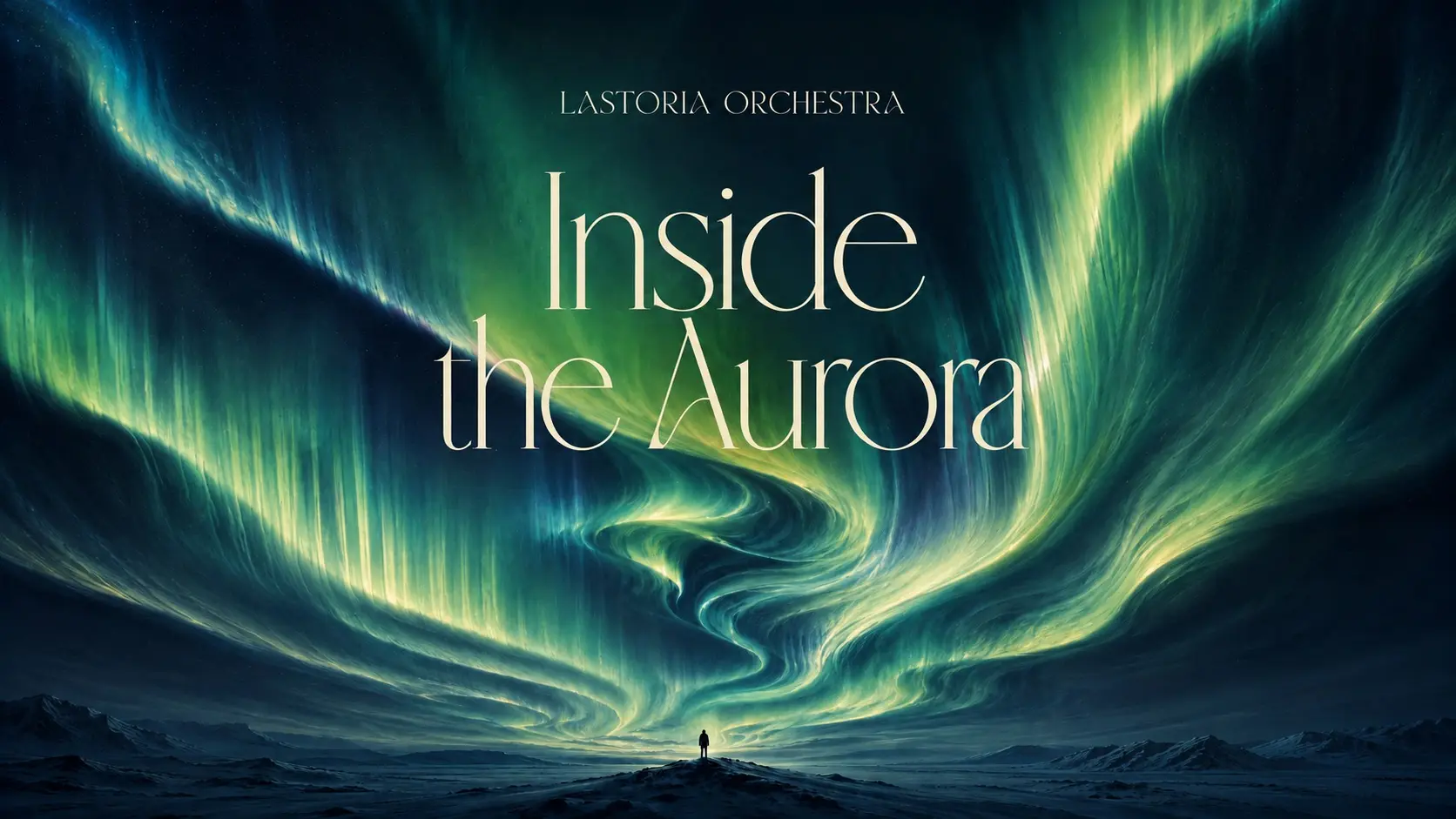
A solitary figure stands beneath an aurora that has occupied almost the entire sky. The luminous bands bend, widen and lift the horizon until the frozen ground no longer feels like a fixed boundary. Inside the Aurora follows the moment when wonder becomes disorientation — and when the person returns to the earth still carrying the light within.
Listen to the composition
Ready to play
When the horizon loses its edge
The night is open and almost without distance. A dark ridge rises only slightly above the frozen plain, and one person stands upon it, small enough to disappear into the horizon. At first the ground is certain: the cold beneath the feet, the low mountains and the long line where snow meets sky.
Then the light gathers. It does not arrive from one direction. Pale green and blue-green curtains descend, fold and turn back upon themselves. The sky becomes deeper than the landscape beneath it. The figure keeps looking upward until the horizon is no longer a border and the earth seems to lose its weight.
For a moment there is no clear above or below. The person is no longer watching the aurora from outside, but appears to stand inside its movement, surrounded by lines of light that open, cross and change shape before they can be understood.
The lights gradually thin. The ridge, the snow and the distant mountains return. The figure is still standing in the same place, but the night is no longer the same. A suspended brightness remains, as though part of the sky has stayed within the person who looked up.
A melody inside moving light
The composition begins as though the listener has entered the luminous space before any conventional introduction can establish the ground. A compact melodic idea rises, bends and returns in altered form, preserving its identity while changing colour and register.
As the music expands, the sense of regular motion becomes less secure. Fragments overlap, the upper space widens and familiar weight begins to dissolve. The central transformation is created through openness and resonance rather than a large external climax.
Only later does a darker lower layer suggest the distant return of the earth. The main idea becomes recognisable again, but no longer feels entirely grounded. The ending is complete, yet leaves the listener inside the afterimage of the aurora.
Credits and information
- Music
- Dmitry Lastov
- Artistic direction
- Dmitry Lastov
- Arrangement
- LASTORIA ORCHESTRA
- Orchestral stylization
- LASTORIA ORCHESTRA
- Performance
- LASTORIA ORCHESTRA
- Format
- Instrumental composition
- Created
- 5 August 2026
- Published
- 6 August 2026